President Donald J. Trump signed H.R. 1945 into law on Nov. 10, formally designating America’s National Churchill Museum (ANCM) a National Historic Landmark.
The America’s National Churchill Museum National Historic Landmark A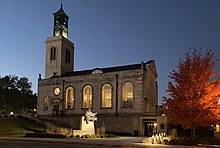 ct recognizes the unique architectural treasure that serves as the home of ANCM — the historic 17th century Church of St. Mary the Virgin, Aldermanbury, on the campus of Westminster College.
The law also calls for a study to explore other options for preserving and sharing the history of ANCM. The National Historic Landmark designation does not, however, automatically make ANCM1 part of the National Park System.
“This is a defining and remarkable milestone for Westminster College, the City of Fulton and the State of Missouri,” said Donald P. Lofe, Jr., President and Chief Transformation Officer of Westminster College. “We sincerely thank President Trump, Representative Bob Onder, Senators Josh Hawley and Eric Schmitt and the bipartisan congressional supporters whose leadership helped secure this recognition, which affirms the College’s significance in the history of international leadership and public service.”
The only structure of its kind in the United States, ANCM was shipped in stone by stone from London and reconstructed in the 1960s at Westminster in memory of Winston Churchill’s world famous “Iron Curtain” speech. The former British prime minister famously delivered the address at Westminster on March 5, 1946.
ANCM’s original architectural framework can be traced at least to the 12th century. Following the Great Fire of London, the Church of St. Mary the Virgin, Aldermanbury, was redesigned by Sir Christopher Wren, only to suffer extensive damage during World War II.
Timothy Riley, the Sandra L. and Monroe E. Trout Director and Chief Curator of America’s National Churchill Museum, emphasized that the law recognizes not only the structure’s unparalleled history but also its national significance. The designation itself is exceptionally rare. A 2018 congressional committee report identified New Mexico’s Fort Bayard Historic District, designated in 2004, as the most recent previous example of a National Historic Landmark designation made directly by an act of Congress.
“When Winston Churchill came to Westminster College, he challenged the world to confront its responsibilities for the future,” Riley reflected. “This extraordinary designation honors that historic moment, the enduring ties between Britain and the United States and the generations who have preserved this exceptional place. It also strengthens our commitment to ensuring that Churchill’s lessons on leadership, freedom and peace continue to inspire future generations.”
A ceremony celebrating National Historic Landmark designation will take place during Churchill Fellows Weekend, themed “Churchill 2046: Lessons for the Next Century, March 19-20, 2027.
“Leave the past to history especially as I propose to write that history myself.”